Home/Publications/Uganda Refugee Economy Outlook
Annual outlook · Humanitarian · First edition, 2026/27
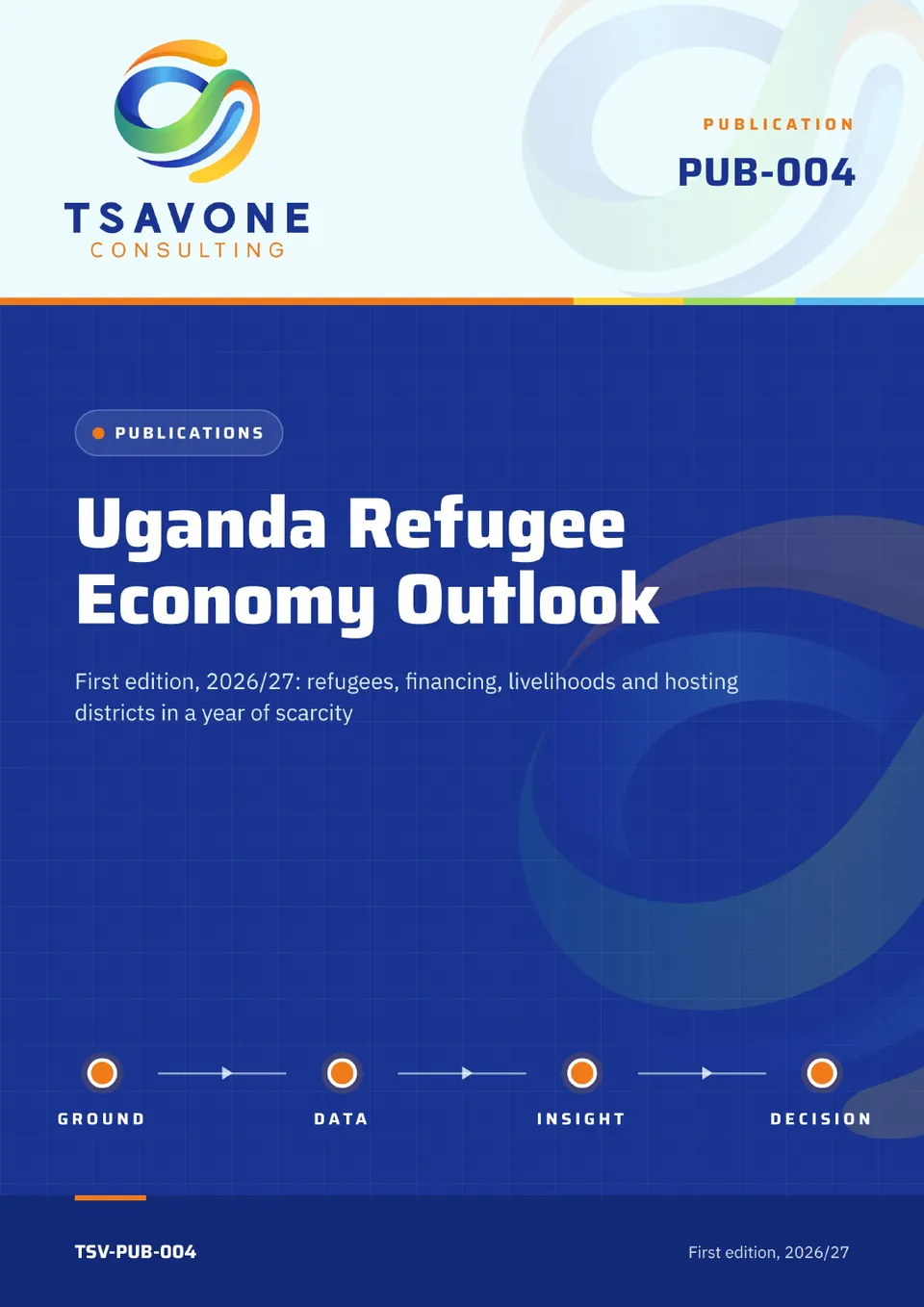
Uganda Refugee Economy Outlook
The first edition of Tsavone's annual Outlook on the economic lives of refugees and their hosts in Uganda. Built from public, cited data, it reports a refugee population above two million, humanitarian funding far below requirements, deep cuts to food assistance and rising malnutrition, alongside new development finance for hosting districts. It sets out three scenarios for 2026/27, implications for decision-makers and the evidence gaps Tsavone will measure in later editions.
At a glance
Key findings
What the evidence says.
Uganda now hosts more than two million refugees and asylum-seekers.
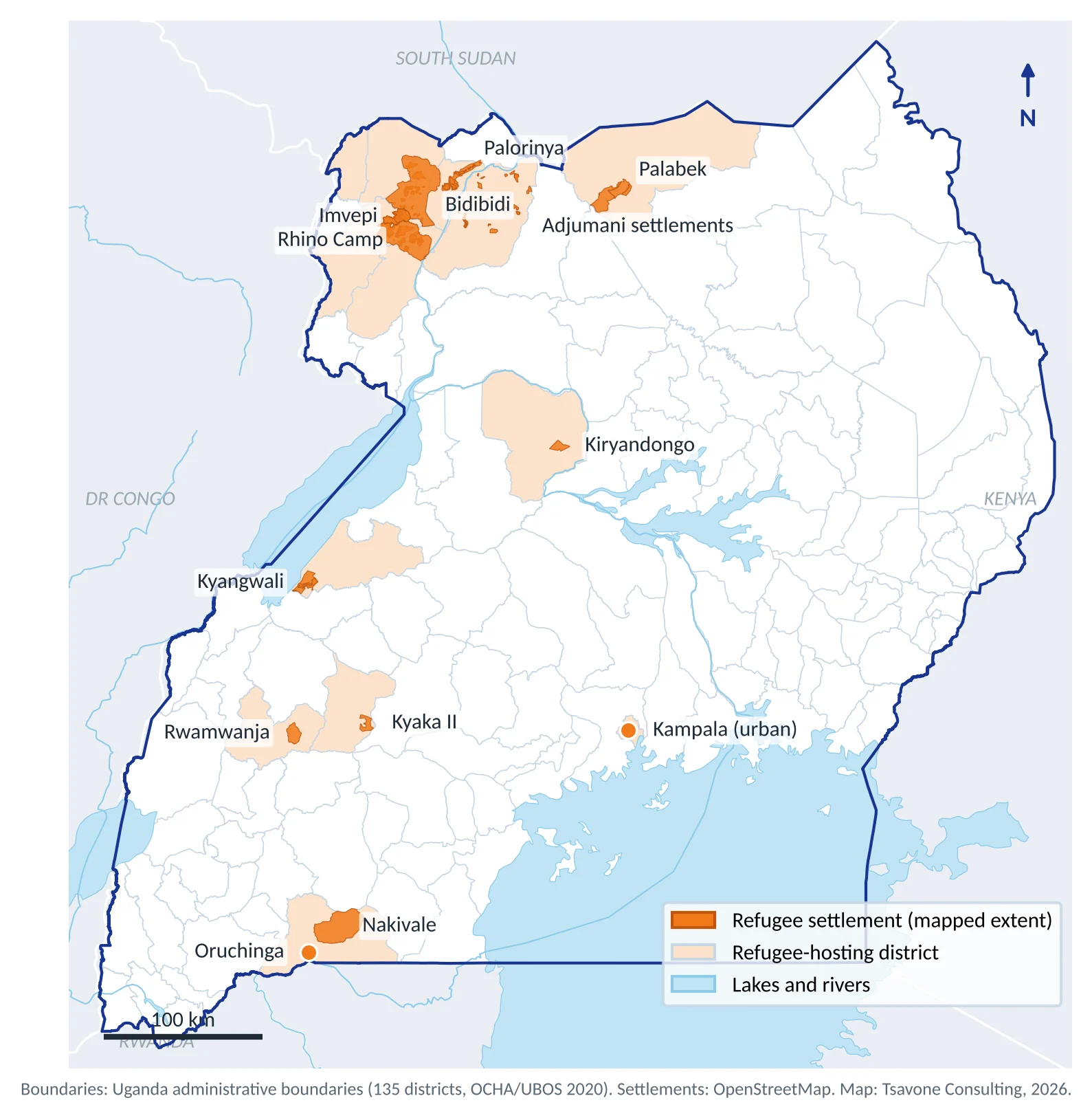
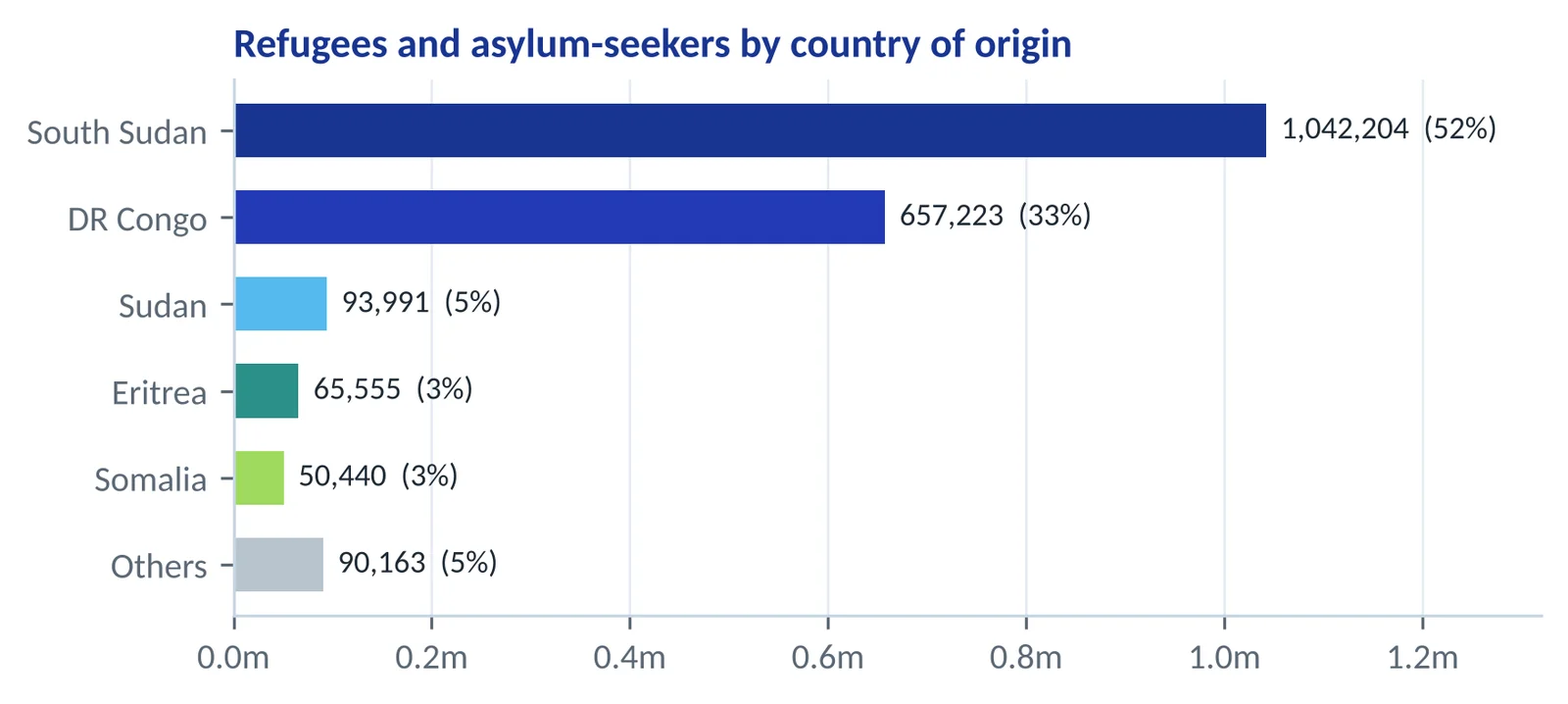
The OPM and UNHCR data portal reports 2,050,820 people as of 30 September 2026: 1,965,952 refugees and 84,868 asylum-seekers (OPM and UNHCR, 2026).
Arrivals have slowed but not stopped.
UNHCR registered 153,933 new asylum-seekers in 2025 (UNHCR, 2026).
The financing model is under the most severe strain in its history.
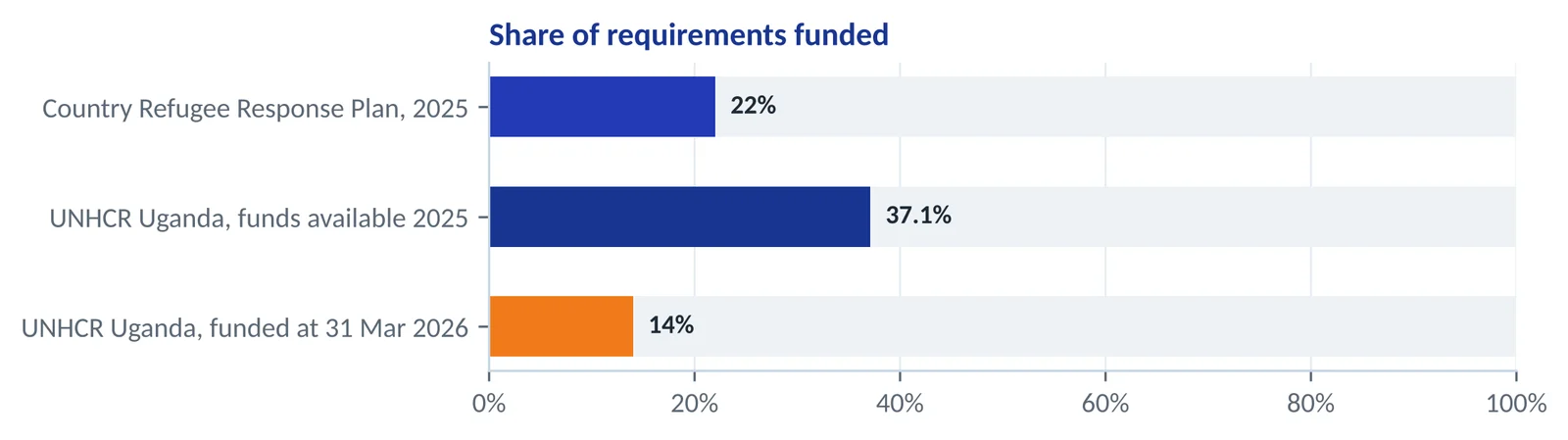
The 2026 Uganda Country Refugee Response Plan seeks US$828.7 million for 2.2 million people, with US$423 million identified as urgently prioritised (UNHCR and partners, 2025).
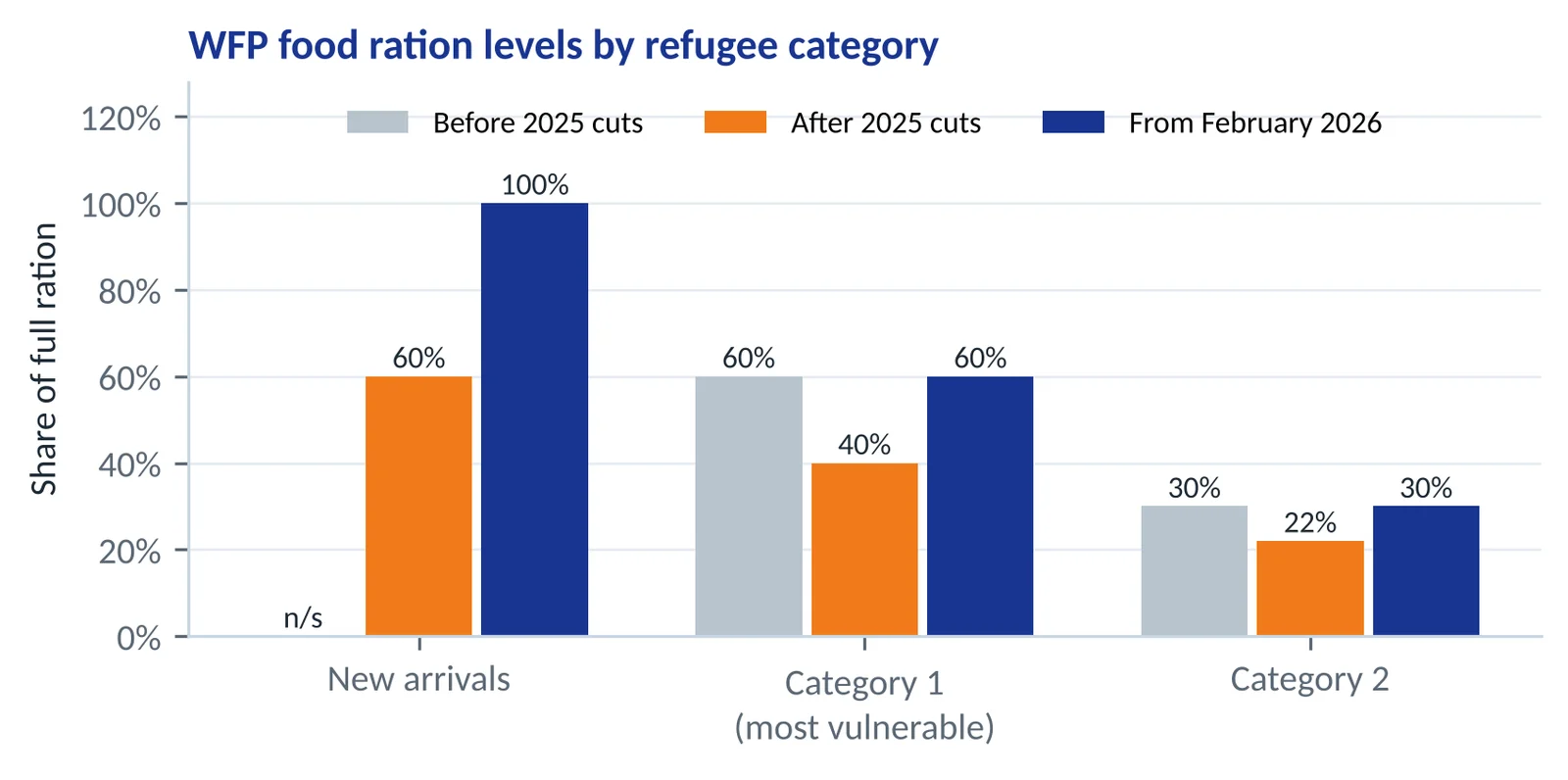
Food assistance has been cut back to the most vulnerable.
WFP reported that the number of refugees it assists fell from 1.6 million in early 2025 to 663,000 by March 2026 (WFP, 2026).
Hunger and malnutrition are rising.
An IPC analysis of 13 settlements and Kampala estimated about 712,000 refugees (37% of those analysed) in Crisis or worse between August 2025 and February 2026 (FAO GIEWS, 2026, citing IPC).
Self-reliance is real but shallow.
Refugees have land and the right to work: UNHCR reports that 74.1% had access to arable land in 2025 and 61.5% held a bank or mobile money account (UNHCR, 2026).
The macroeconomic setting has tightened sharply.
Uganda's economy grew by an estimated 6.4% in 2025/26 (UBOS, 2026).
Development finance is the main new money.
The second phase of the Development Response to Displacement Impacts Project (DRDIP II), a US$328 million, five-year programme for 14 refugee-hosting districts, was due to start in October 2026 (Parliament of Uganda, 2026).
Our central outlook
Our central scenario is managed contraction: the refugee population stays between 2.0 and 2.2 million, humanitarian funding stays at or below one third of requirements, food insecurity in settlements stays at Crisis level through the first half of 2027, and the main growth in support comes from development-financed programmes in hosting districts. The main downside risk is a new large influx combined with a 2027 food pipeline break. The main upside is faster delivery of development finance and wider refugee access to credit, markets and national services. Section 10 sets out the signals to watch.
Maps and charts
Selected figures from the outlook.
For decision-makers
Five messages for decision-makers.
- Plan for scarcity as the norm, not a temporary gap. Programme designs that assume a return to 2023 funding levels will fail.
- Measure self-reliance with income and consumption, not with participation counts. The gap between 223,463 'economic opportunities' created and 5.8% of refugees reporting income gains shows why.
- Treat refugee-hosting districts as one economy. Host and refugee households trade, hire and farm together; investments that serve both perform better and are easier to defend politically.
- Protect the nutrition floor. Malnutrition rose fastest where rations were cut. Cuts to the last 60% ration for the most vulnerable carry large, costly and partly irreversible harm.
- Build the evidence base now. Uganda lacks a recent, public, representative survey of refugee welfare. The joint World Bank and UNHCR analysis of the 2023/24 national household survey, when published, should become the reference point.
Inside the full outlook
28 pages of sourced evidence.
Every figure is traced to a public source listed in the outlook. Download it free, share it, and cite it.
- About this Outlook
- Executive summary
- Key indicators
- Population and movement
- Financing the response
- Food, assistance and nutrition
- Livelihoods and self-reliance
- Services and inclusion in national systems
- The macroeconomic setting
- Outlook for 2026/27
- Implications for decision-makers
- Evidence gaps and what Tsavone will measure
- Methods note
- Sources
How to cite: Tsavone Consulting (2026). Uganda Refugee Economy Outlook. First edition, 2026/27. Publication TSV-PUB-004. Kampala, Uganda: Tsavone Consulting. Lead author: Patrick Engoru. Available at: www.tsavone.com/publications