Home/Publications/Nature and Climate Risk in Ugandan Business
Annual outlook · Nature and climate · First edition, 2026
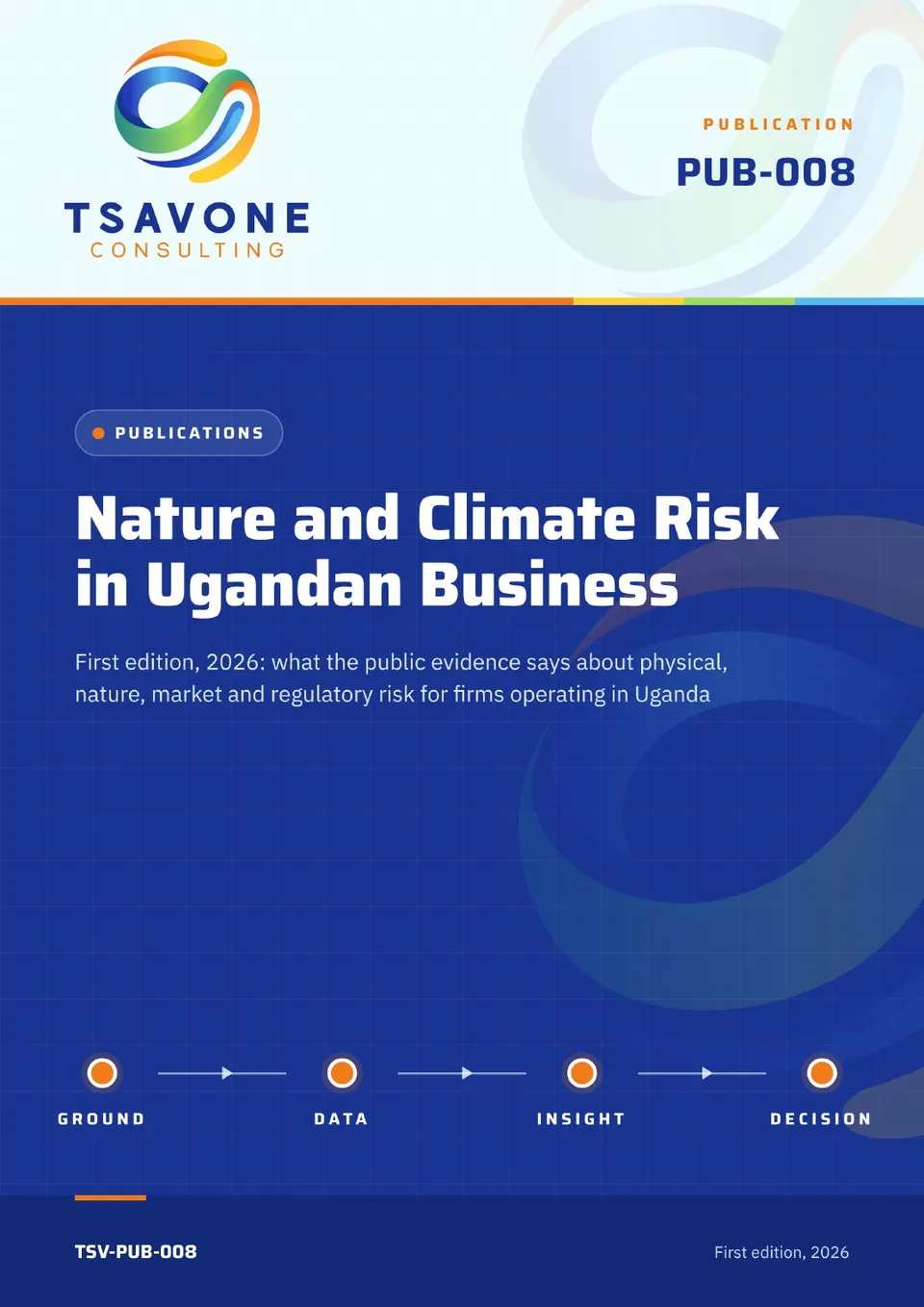
Nature and Climate Risk in Ugandan Business
The first edition of Tsavone Consulting's annual review of nature and climate risk for businesses in Uganda. It brings together recent official and published data on climate hazards, forest and wetland loss, trade rules such as the EU Deforestation Regulation, and new Bank of Uganda climate risk rules, and sets out what they mean for decision-makers. Every figure is sourced; gaps are named and become the measurement agenda for later editions.
At a glance
Key findings
What the evidence says.
Physical climate risk is already material.
The World Bank's Country Climate and Development Report (CCDR, September 2025) estimates that without strong action climate change could reduce Uganda's GDP by up to 3.1 per cent by 2050, push more than 613,000 people into poverty and create up to 12 million additional internal migrants.
Uganda is among the least prepared countries.
On the Notre Dame Global Adaptation Initiative (ND-GAIN) index, Uganda scores 34.4 and ranks 172nd, with a vulnerability score of 0.536 and a readiness score of 0.224 (2023 data).
2026 is an El Niño year.
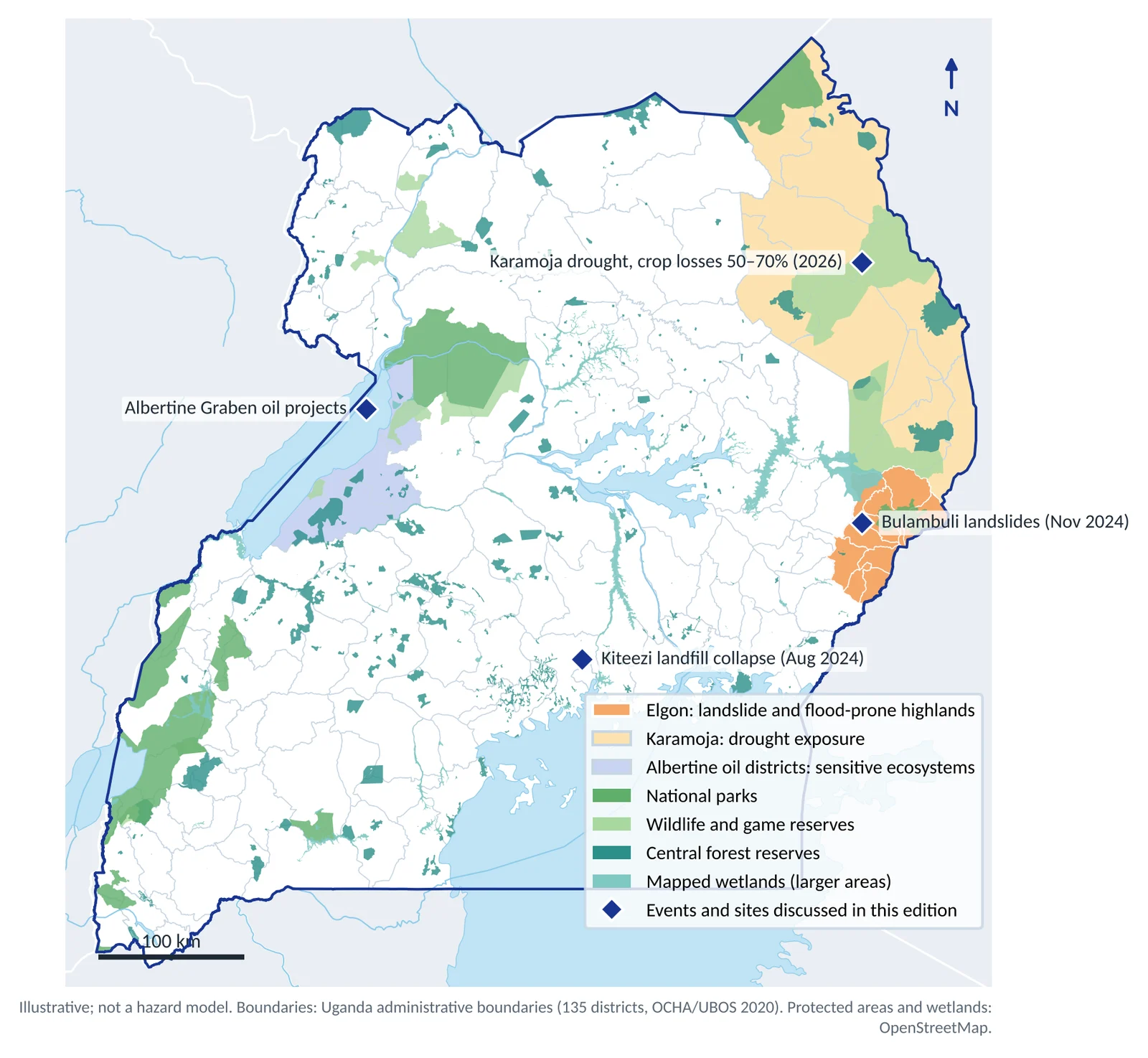
FEWS NET's June 2026 outlook reports strengthening El Niño conditions with a strong positive Indian Ocean Dipole, below-average rain in Karamoja to September and above-average rain in bimodal areas from September to December.
The natural base is shrinking.
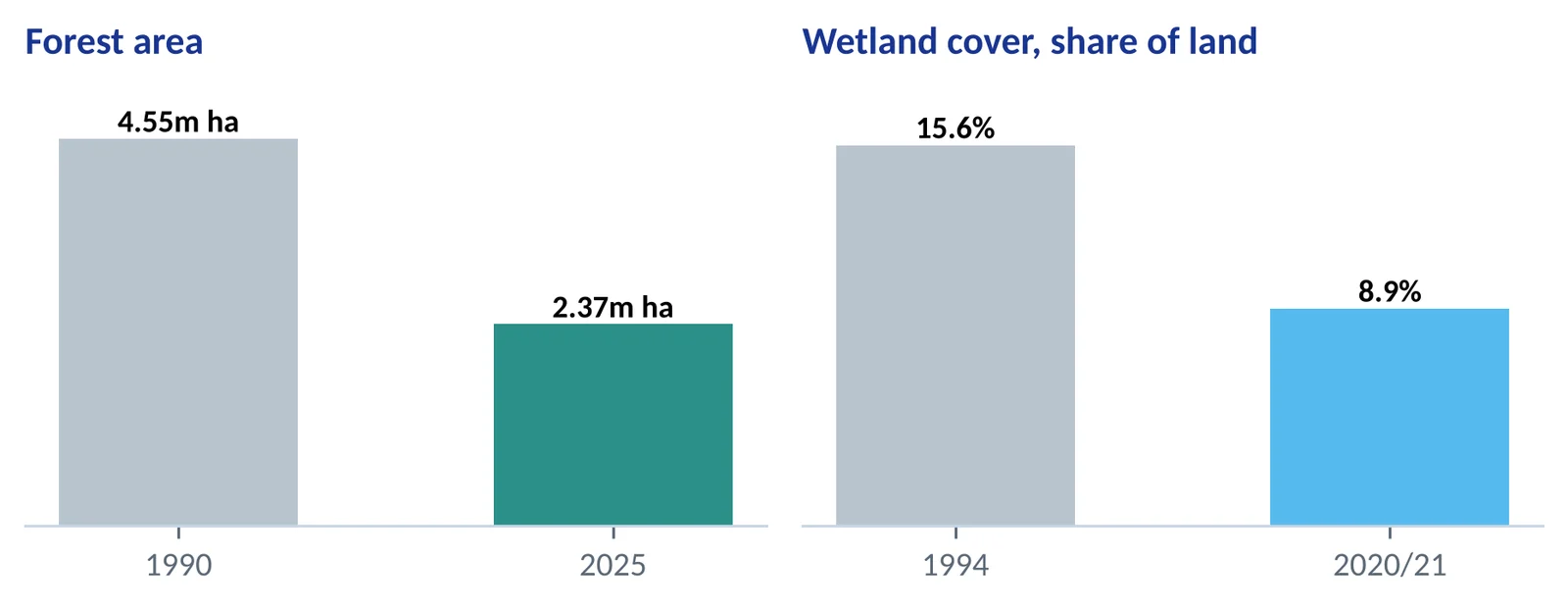
Media reporting of the FAO Global Forest Resources Assessment 2025 puts Uganda's forest area at 2.37 million hectares in 2025, against 4.55 million in 1990, with net loss of about 38,000 hectares a year in 2020 to 2025.
Trade rules now price deforestation.
The amended EU Deforestation Regulation (EUDR) applies from 30 December 2026 for most operators and 30 June 2027 for certain micro and small operators.
Banks must now manage climate risk.
Bank of Uganda Guidelines for the Management of Climate-related Financial Risks took effect on 31 December 2025.
A green finance architecture is being built.
Government launched the National Green Taxonomy and the National Climate Finance Strategy 2025 to 2030 on 11 September 2025.
Carbon markets have rules.
The National Climate Change (Climate Change Mechanisms) Regulations, 2025 were gazetted on 24 January 2025 and set approval, registry, verification and international transfer rules under Article 6 of the Paris Agreement.
Maps and charts
Selected figures from the outlook.
For decision-makers
What decision-makers should do in the next 12 months.
- Boards should put nature and climate risk on the risk register, name an accountable executive, and review exposure in the 2026 El Niño season.
- Exporters of coffee, cocoa, timber, cattle products and soy should complete plot-level traceability and a deforestation and legality risk assessment by 30 December 2026, or as soon as possible after it.
- Borrowers should prepare the climate information their bank will now request: locations, exposure, and plans.
- Banks, insurers and investors should map portfolio concentration by sector and district against hazard data, and use the National Green Taxonomy to label green lending.
- Government and development partners should fund district-level hazard and asset data, and a public loss and damage database, so that private actors can price risk.
Inside the full outlook
28 pages of sourced evidence.
Every figure is traced to a public source listed in the outlook. Download it free, share it, and cite it.
- About this publication
- Executive summary
- Why nature and climate risk matters for Ugandan business
- Key indicators at a glance
- Physical climate risk
- Nature: dependencies, degradation and risk
- Market and trade risk: the EU Deforestation Regulation and buyer expectations
- Policy and regulatory risk
- The financial system: banks, insurers and investors
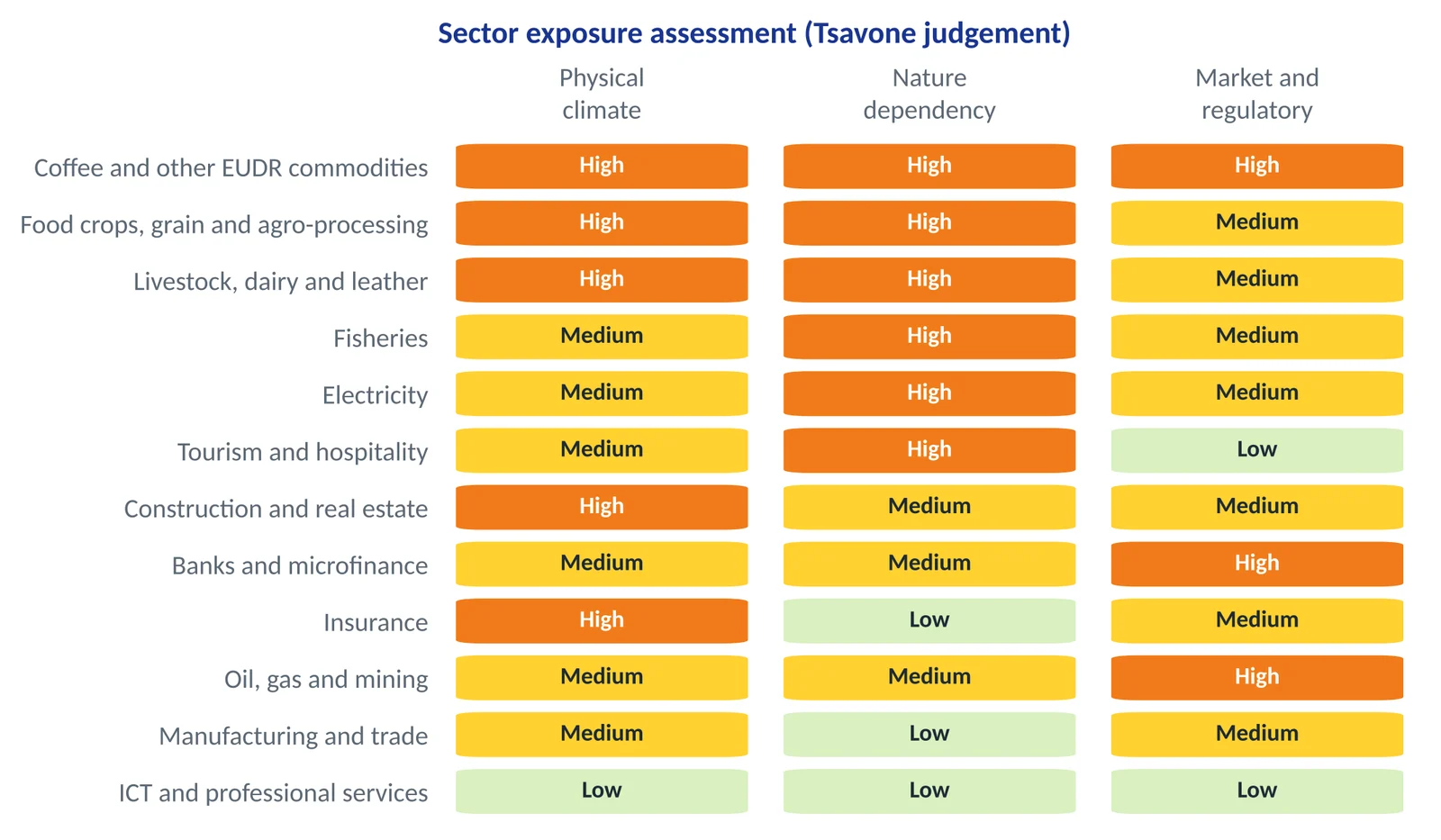
- Sector exposure assessment (Tsavone judgement)
- Outlook: 2027 and beyond
- Implications for decision-makers
- What Tsavone will measure in later editions
- Methods note
How to cite: Tsavone Consulting (2026). Nature and Climate Risk in Ugandan Business. First edition, 2026. Publication TSV-PUB-008. Kampala, Uganda: Tsavone Consulting. Lead author: Patrick Engoru. Available at: www.tsavone.com/publications