Home/Publications/Uganda Agrifood Outlook
Annual outlook · Agrifood · First edition, 2026/27
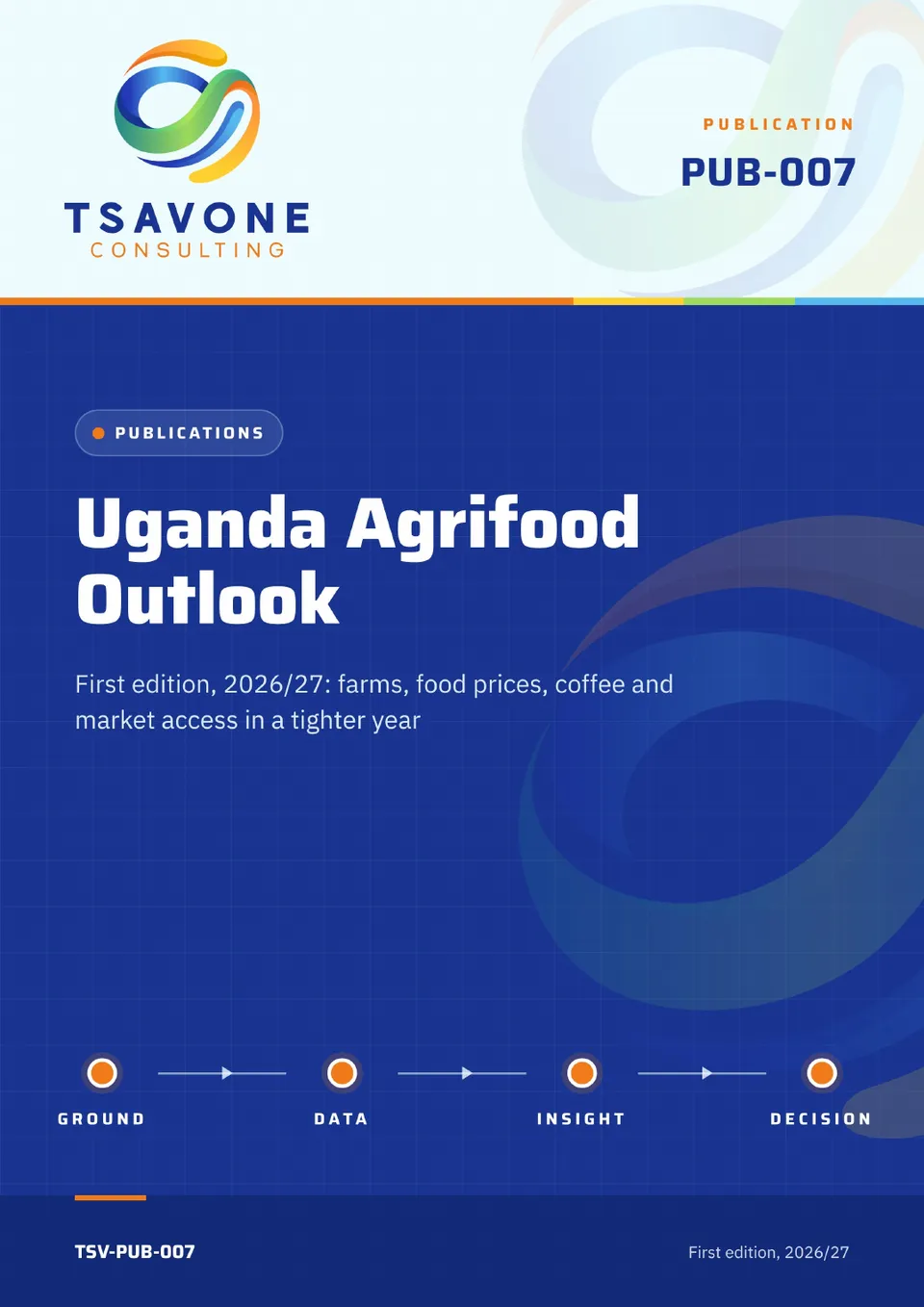
Uganda Agrifood Outlook
The first edition of Tsavone's annual Outlook on Uganda's agrifood system, built from public, cited data. It reports strong agricultural growth in 2025/26 followed by drought in Karamoja, falling coffee earnings, rising food prices and an emergency interest rate rise, and reviews 2026/27 budget measures and EUDR readiness. It sets out three scenarios for 2026/27, implications for decision-makers and the evidence gaps Tsavone will measure in later editions.
At a glance
Key findings
What the evidence says.
Agriculture grew strongly in 2025/26 but the second half of 2026 has been harder.
UBOS preliminary estimates put agriculture's share of GDP at 26.2% in 2025/26, with growth of 6.5%, led by cash crops (12.1%) while food crops grew by 4.9% (UBOS, as reported by Daily Monitor, 2026).
Coffee earnings peaked and are now falling.
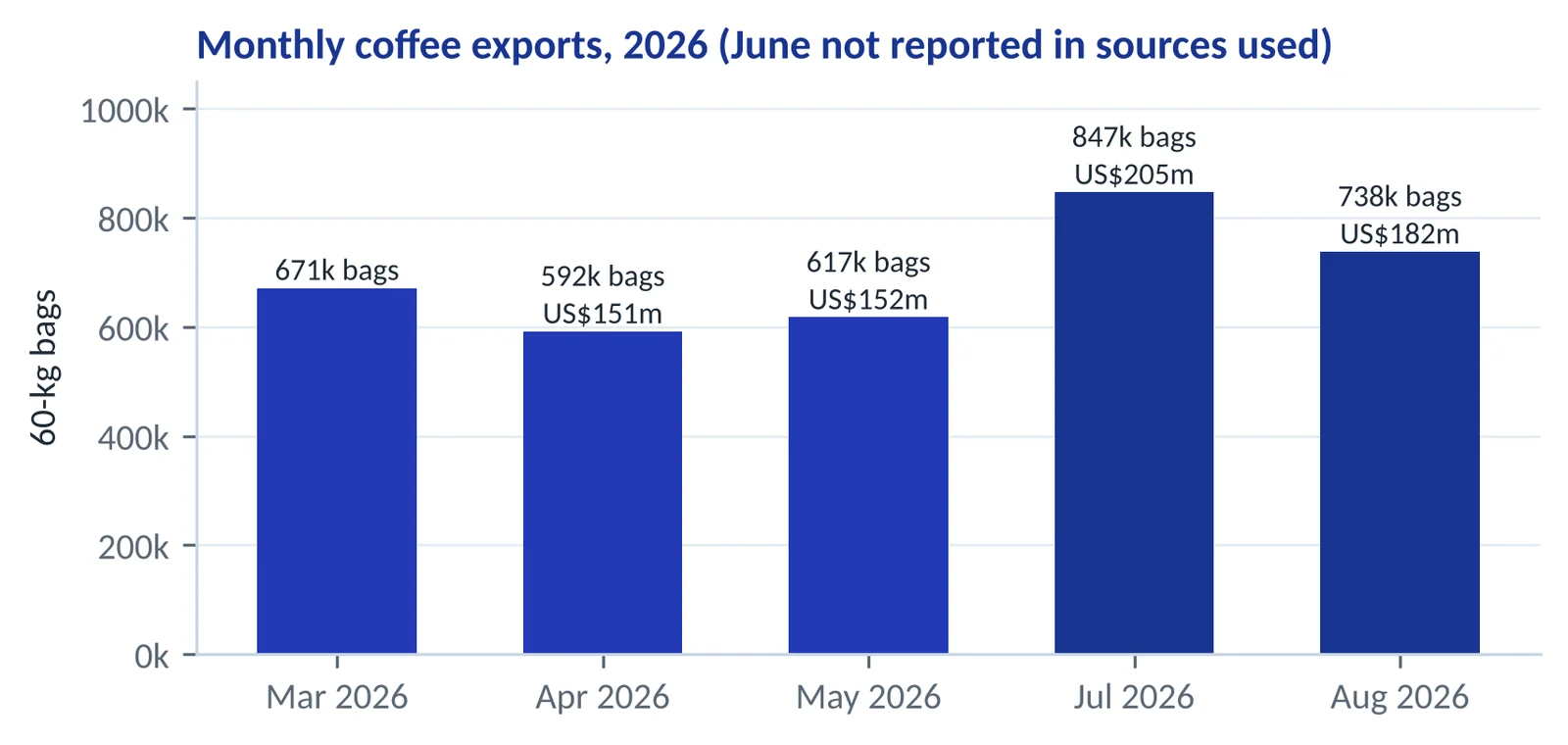
Coffee exports earned about US$2.27 billion from 7.93 million 60-kg bags in the year from September 2024 to August 2025 (MAAIF, as reported by Food Business MEA, 2025), and about US$2.4 billion in the twelve months to March 2026 (CMB News, 2026).
Gold, not agriculture, now drives export growth.
In July 2026 gold earned US$788.45 million of US$1.402 billion in merchandise exports, while coffee earned US$204.94 million (MoFPED, as reported by Daily Monitor, 2026).
Food prices have turned up.
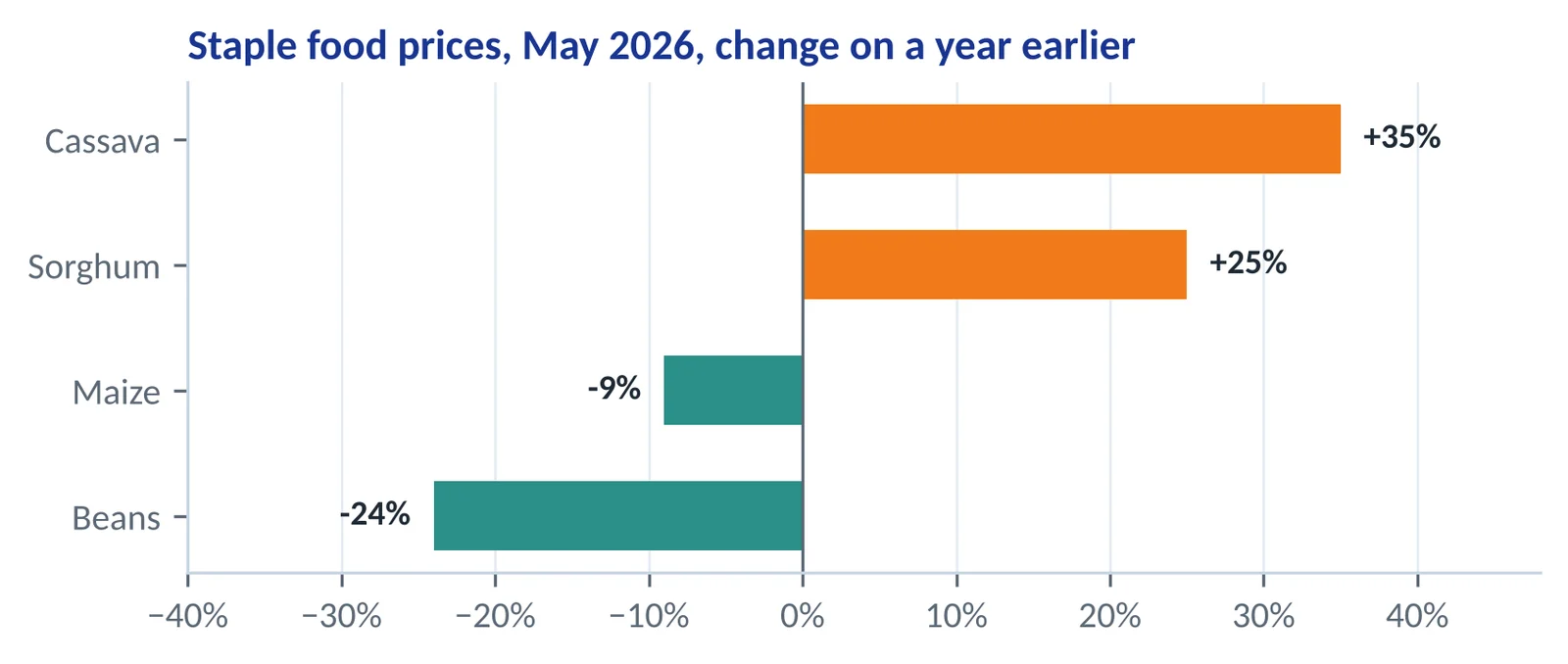
Headline inflation rose to 4.6% in September 2026 and food inflation to 4.7% (UBOS, via Trading Economics, 2026).
Hunger is rising, especially in Karamoja and refugee settlements.
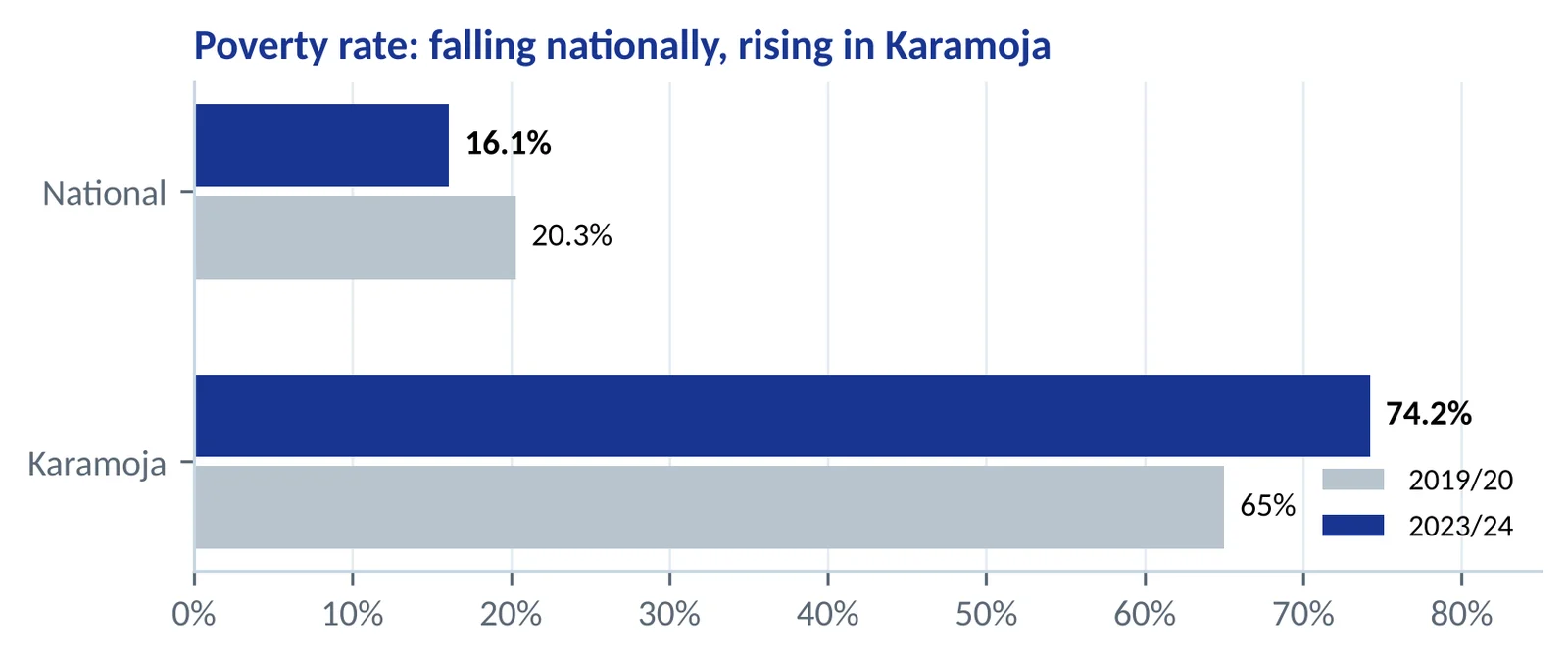
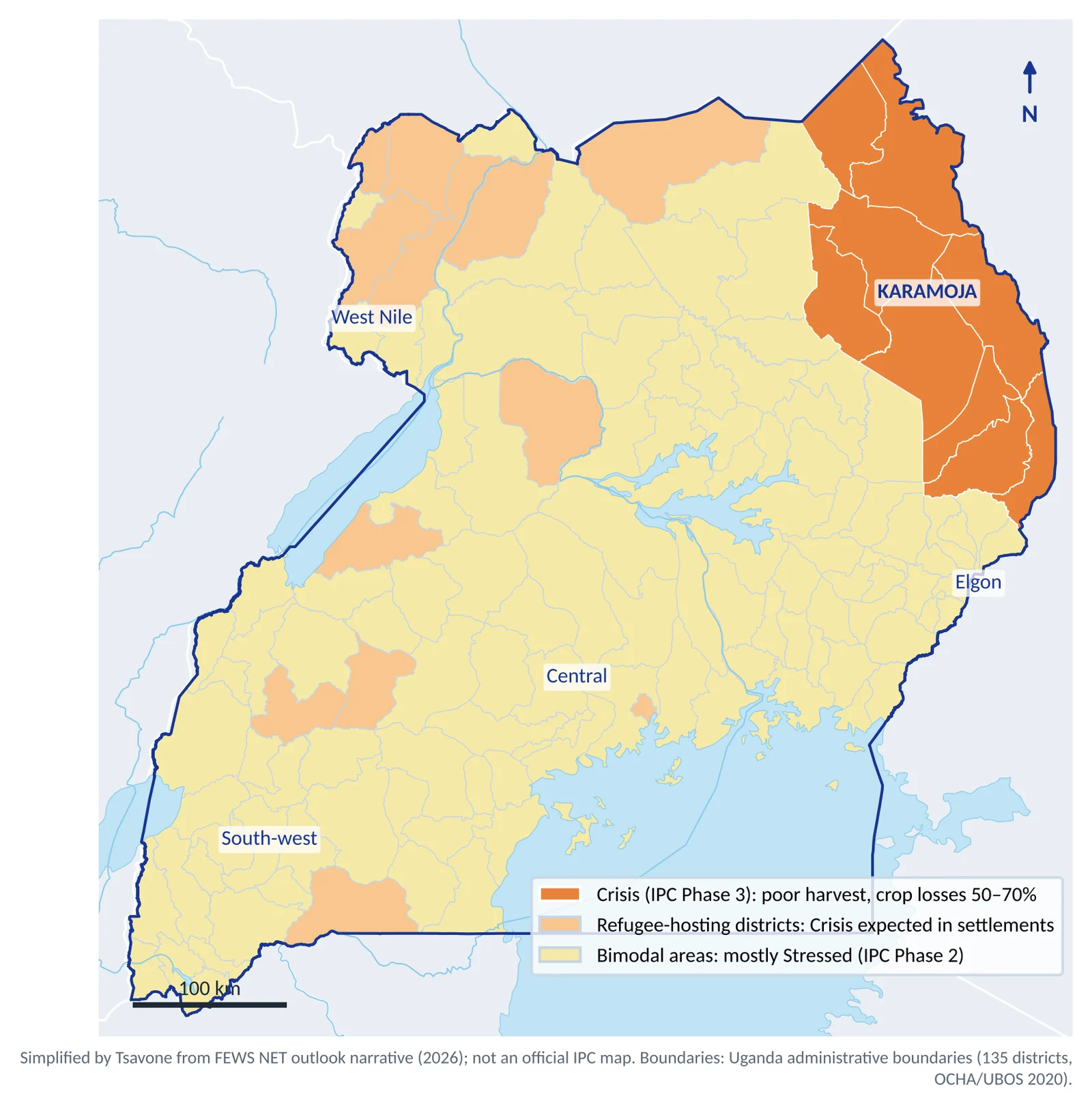
The national IPC analysis released on 22 October 2026 reported about 3.6 million people in high acute food insecurity in August and September 2026, projected to reach 4.4 million in February to June 2027 (Nile Post and Daily Monitor, 2026, reporting IPC).
Public money for agriculture is concentrated in a few large programmes.
The approved 2026/27 budget of Shs84.39 trillion allocates Shs2.26 trillion to agro-industrialisation and Shs2.43 trillion to wealth creation, including Shs1.059 trillion for the Parish Development Model (PDM) and Shs50 billion for the Agricultural Credit Facility (KPMG, 2026).
EUDR compliance is now urgent.
The EU Deforestation Regulation applies to large and medium operators from 30 December 2026 and to micro and small operators outside timber from 30 June 2027 (Hogan Lovells, 2026).
Our central outlook
Our central scenario is slower growth under tighter money: agriculture continues to grow but below 2025/26 rates; coffee earnings are lower than in 2025/26 because of lower prices and drought-affected volumes; food prices rise through the first half of 2027; Karamoja and refugee settlements stay in Crisis; and the September to December rains, forecast near-normal to above-normal, support second-season food crops but bring flood and post-harvest losses. Section 12 sets out the downside and upside cases and the signals to watch.
Maps and charts
Selected figures from the outlook.
For decision-makers
Five messages for decision-makers.
- Prepare for lower coffee earnings in 2026/27 and protect farmer margins through quality, aggregation and EUDR-ready traceability, not volume alone.
- Treat food price risk as a household welfare risk. Poor households, refugees and Karamoja pastoralists buy much of their food and are most exposed to the current rise.
- Use the second season. Above-normal rain can raise food output if seed, labour and storage are ready; it can also raise aflatoxin and post-harvest losses if they are not.
- Link public programmes to market outcomes. Report PDM and Agricultural Credit Facility results in farmer income, yields and sales, not only disbursements.
- Invest in evidence. Uganda lacks a recent public series on farm-gate prices, yields and farm incomes by region. The next national agricultural survey results should be published in full.
Inside the full outlook
26 pages of sourced evidence.
Every figure is traced to a public source listed in the outlook. Download it free, share it, and cite it.
- About this Outlook
- Executive summary
- Key indicators
- Agriculture in the economy
- The 2026 seasons
- Food prices and inflation
- Food security and nutrition
- Agricultural exports and trade
- Public spending, credit and tax
- Market access: EUDR and standards
- Climate and other risks
- Outlook for 2026/27
- Implications for decision-makers
- Evidence gaps and what Tsavone will measure
- Methods note
- Sources
How to cite: Tsavone Consulting (2026). Uganda Agrifood Outlook. First edition, 2026/27. Publication TSV-PUB-007. Kampala, Uganda: Tsavone Consulting. Lead author: Patrick Engoru. Available at: www.tsavone.com/publications